
From Ions to the Field: How Solid Oxide Fuel Cells Turn Chemical Energy into Reliable Off-Grid Power
From electrochemistry to a propane-powered system for critical remote infrastructure
From combustion to electrochemical power
When we think of off-grid power generation, the image that often comes to mind is a noisy, fuel-burning generator producing electricity through combustion.
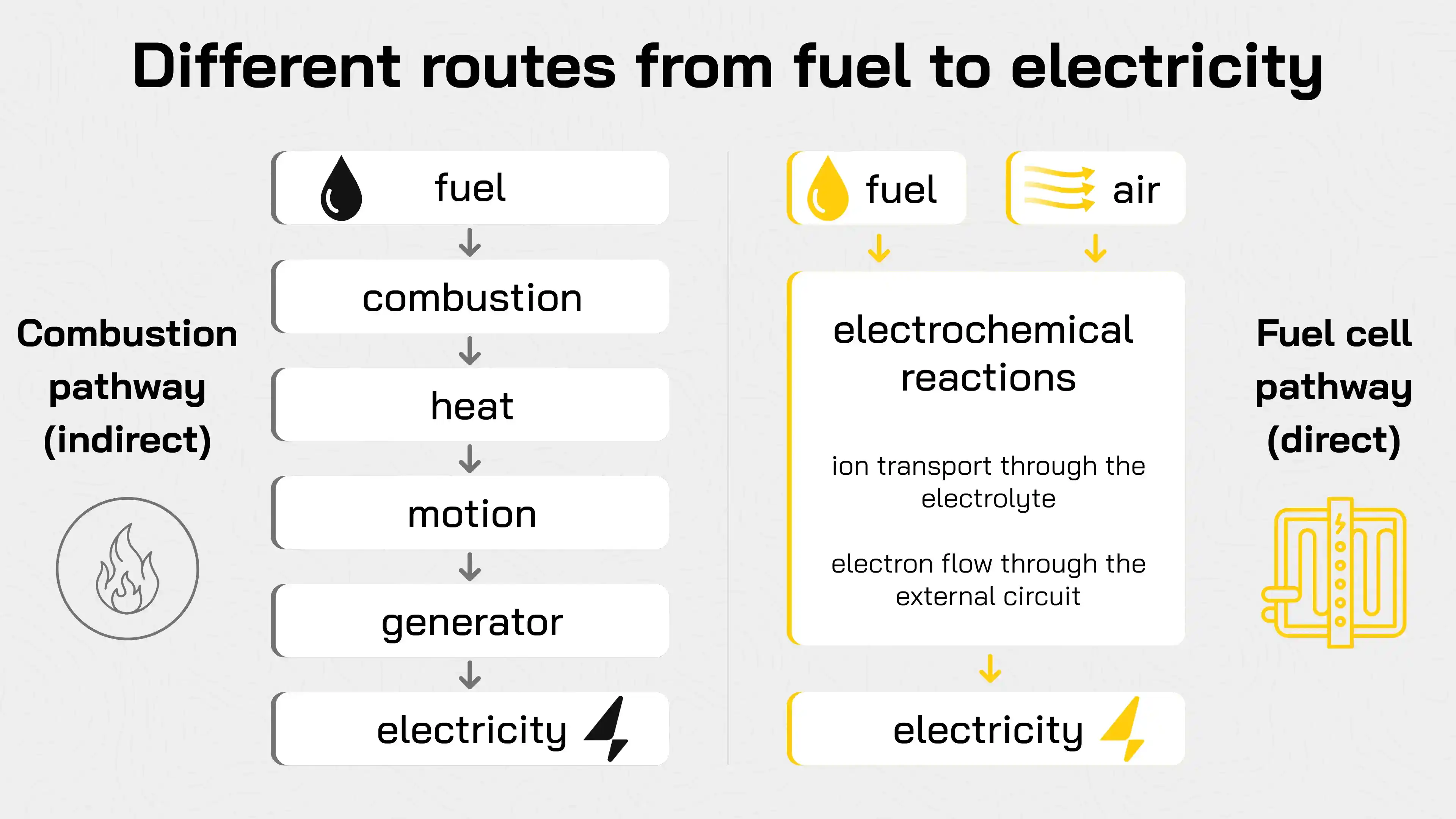
These conventional generators release the chemical energy stored in fuel by burning it. That energy becomes heat, that heat drives mechanical motion inside an engine, and a rotating generator converts that motion into electricity. Each conversion step introduces losses, while the engine brings moving components, noise and maintenance requirements.
Fuel cells offer another route. They convert the chemical energy of a fuel into electricity through electrochemical reactions, without first using combustion to drive an engine. Different fuel cell technologies use different materials, operate at different temperatures and process different fuels. Proton-exchange membrane fuel cells, direct methanol fuel cells and solid oxide fuel cells, like INERGIO Mini, each follow their own electrochemical pathway and suit different applications.
Among them, solid oxide fuel cells, or SOFCs, are defined by two central characteristics: a solid ceramic electrolyte and high-temperature operation. Together, these determine how ions move through the cell, which fuels the system can process and how the surrounding equipment must be engineered.
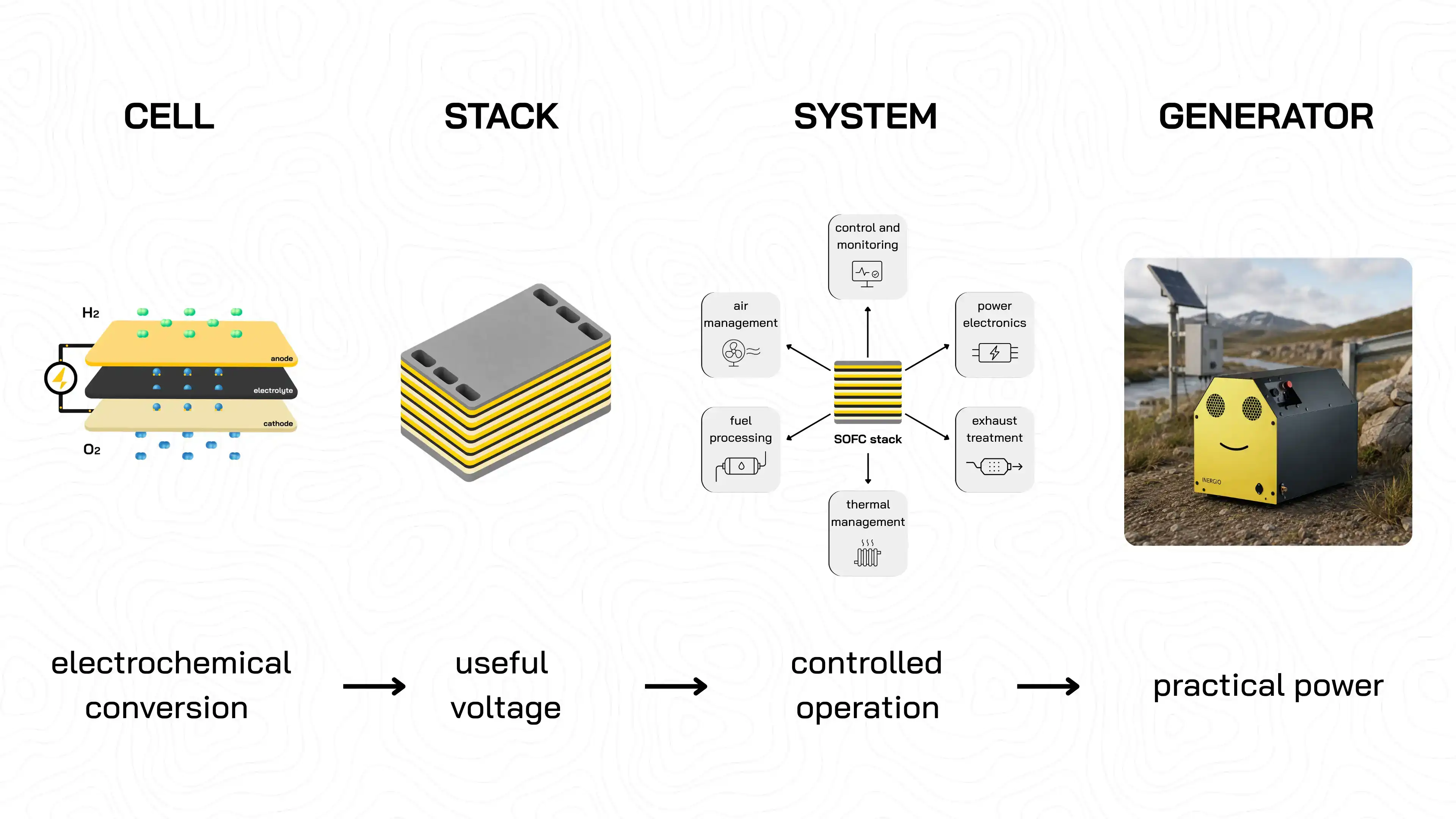
Yet the electrochemical reaction is only the centre of the technology. Before microscopic ion movement can power a camera, traffic system or remote monitoring station, it must be organised inside a cell, multiplied across a stack and supported by a complete system managing fuel, air, heat, electricity and time.
Inside a solid oxide fuel cell
An SOFC contains three active layers: an air electrode, a solid ceramic electrolyte and a fuel electrode. Air reaches one side of the cell and fuel reaches the other. The electrolyte keeps them separated while allowing oxide ions to pass through.
Hydrogen provides the clearest explanation. Oxygen from the air receives electrons at the air electrode and forms oxide ions:
The oxide ions cross the ceramic electrolyte and react with hydrogen at the fuel electrode, forming water and releasing electrons:
The electrolyte transports ions but blocks electrons. Those electrons must travel through an external circuit, where their movement becomes useful electric current.
The overall reaction is the familiar formation of water from hydrogen and oxygen. The separated pathway allows electrical work to be extracted before the remaining energy appears as heat. The electrodes are porous so gases can reach the reaction sites, while the electrolyte is dense enough to keep fuel and air apart.
The movement of ions through a solid is possible because the ceramic’s crystal lattice contains carefully created empty oxygen positions, known as oxygen vacancies. An oxide ion can move into a neighbouring vacancy, leaving a new vacancy behind. As this continues, ions progress through the electrolyte even though the ceramic itself remains structurally fixed. A common SOFC electrolyte is yttria-stabilised zirconia, or YSZ, a ceramic engineered to create these vacancies and conduct oxide ions at elevated temperatures.
This combination of solid structure and ionic movement gives the technology its name: solid oxide fuel cell.
Why high temperature defines the system
At room temperature, oxide ions cannot move through the ceramic fast enough to support practical power generation. Heat increases ionic conductivity and accelerates the reactions at both electrodes. Depending on their materials and architecture, SOFCs commonly operate across a broad high-temperature range of approximately 500 °C to 1,000 °C.
That temperature supports some of the technology’s most useful characteristics. It enables rapid electrochemical reactions, reduces dependence on precious-metal catalysts and makes it possible to convert fuels such as natural gas, biogas or propane into gases the stack can use.
This fuel-processing capability gives SOFCs an important degree of fuel flexibility. Instead of depending exclusively on externally supplied pure hydrogen, the system can convert suitable hydrocarbon fuels into a hydrogen- and carbon-monoxide-rich gas that the stack can use electrochemically.
Fuel flexibility does not mean that any fuel can be connected without preparation. Each fuel requires compatible reforming, cleaning, control and system validation.
High temperature also poses some of the most demanding engineering challenges. Ceramics, metals and seals respond differently as they heat and cool. The hot core requires insulation, controlled start-up and shutdown, stable gas flow and careful thermal management.
Meeting these demands requires the right architecture around the high-temperature electrochemistry, turning microscopic ion movement into a robust, reliable power system for critical field operations.
From a planar cell to a complete power system
A single cell produces limited voltage, so multiple planar cells are connected to form a stack. The stack must distribute fuel and air across every cell, collect electrical current, keep the gas streams separated and maintain suitable sealing and temperature uniformity. Interconnects link the individual cells electrically to increase useful voltage and power.
Yet the stack remains only the electrochemical core.
A practical generator also needs pressure and flow regulation, sulphur protection, fuel reforming, air management, insulation, heat exchange and exhaust post-processing. Sensors and controls coordinate its operation, while a DC/DC converter conditions the stack output for the battery and connected equipment. Communications provide visibility when the system operates unattended.
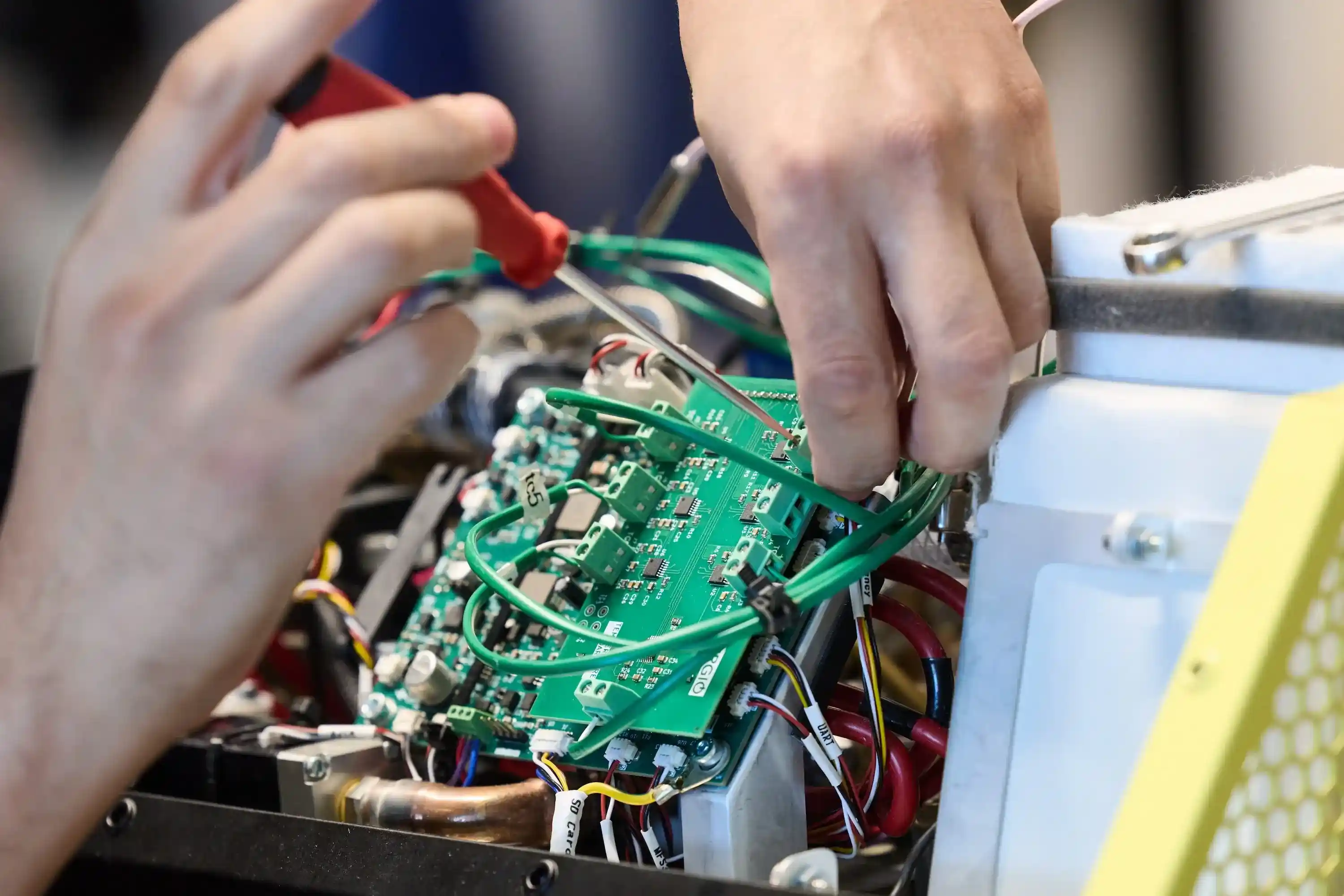
These surrounding functions are often called the balance of plant. Together, they transform a hot electrochemical stack into a power system that can start automatically, use commercial fuel and deliver controlled electricity outside laboratory conditions.
No single component explains the generator. Its performance emerges from the way all the components work together.
Following propane through INERGIO Mini
INERGIO Mini uses standard commercial propane, a widely available fuel stored in sealed cylinders or tanks. For remote operators, this means access to established supply channels without depending on dedicated hydrogen infrastructure or proprietary fuel cartridges. Its high energy density also makes propane practical where long autonomy is required and the fuel must be transported or stored on site.
The fuel follows a defined functional sequence:
Pressure and flow regulation prepare the fuel, while sulphur protection helps protect the catalytic components. The internal reformer then converts propane into a hydrogen- and carbon-monoxide-rich gas mixture that the stack can use electrochemically.
How effectively this conversion takes place matters directly in the field. A higher conversion rate means that more of the fuel stored on site becomes available to the electrochemical process. Under tested conditions, INERGIO’s reformer achieved propane conversion above 97%. Stable operation at the low fuel flows required by a compact 140 - 170W system is supported by dedicated propane sensing and fuel management.
Inside the planar stack, the reformed gas reacts with oxide ions to produce DC electricity, heat, water and carbon dioxide. Remaining fuel is treated in the post-processing stage and afterburner before the exhaust leaves the system. Under the tested flow conditions, carbon-monoxide concentrations after post-processing remained below 50 ppm. A heat exchanger supports thermal management, while dedicated DC/DC conversion adapts the stack’s low-voltage, high-current output for use by the battery system.
The efficient use of fuel also affects the system’s environmental performance. Propane contains carbon and therefore produces CO₂, but the amount of fuel required for each kilowatt-hour is substantially lower than for a small combustion generator operating at low load. INERGIO’s lifecycle analysis estimates approximately 737 g CO₂-equivalent per kWh for propane, compared with more than 1,900 g for small conventional generators under the study assumptions. With bio-propane, the estimate falls to approximately 239 g CO₂-equivalent per kWh, offering a pathway to lower emissions while retaining the same storage and fuel-handling advantages.
For a closer look at fuel availability, autonomy and off-grid logistics, read Why propane is the ideal fuel for powering off-grid operations.
Completing the system with batteries and solar
The battery and the SOFC perform different jobs. A battery responds immediately to changing demand and supplies short power peaks. The SOFC delivers energy over longer operating periods and restores charge to the battery.
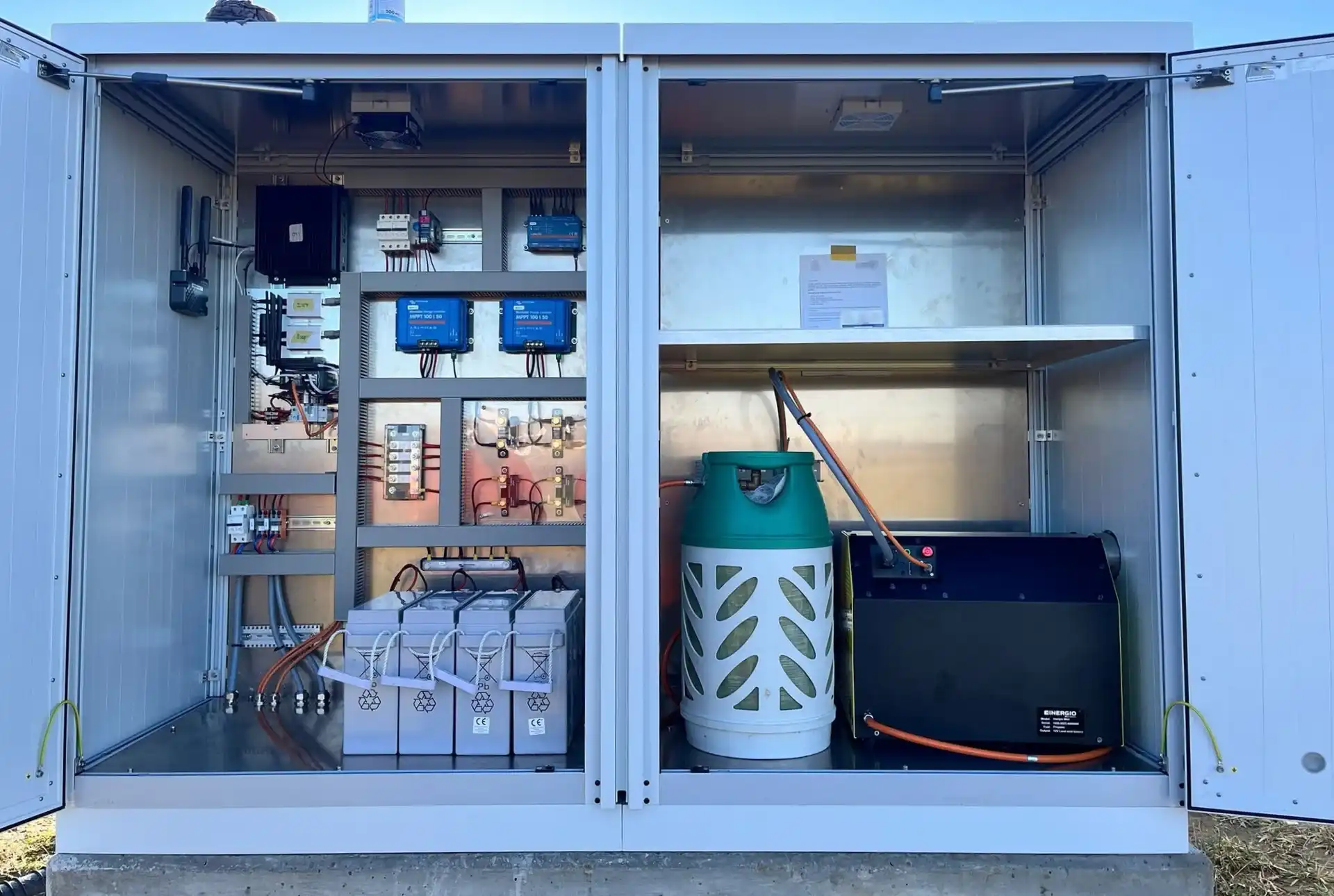
INERGIO Mini monitors battery voltage and starts when the battery requires support. It then supplies power and charges the battery before shutting down at the configured upper threshold.
Solar can provide the first layer of energy when conditions are favourable, while INERGIO covers prolonged gaps caused by winter, cloud cover, shade or limited panel space. In locations where solar is impractical, INERGIO can act as the primary energy source while the battery remains the immediate electrical buffer.
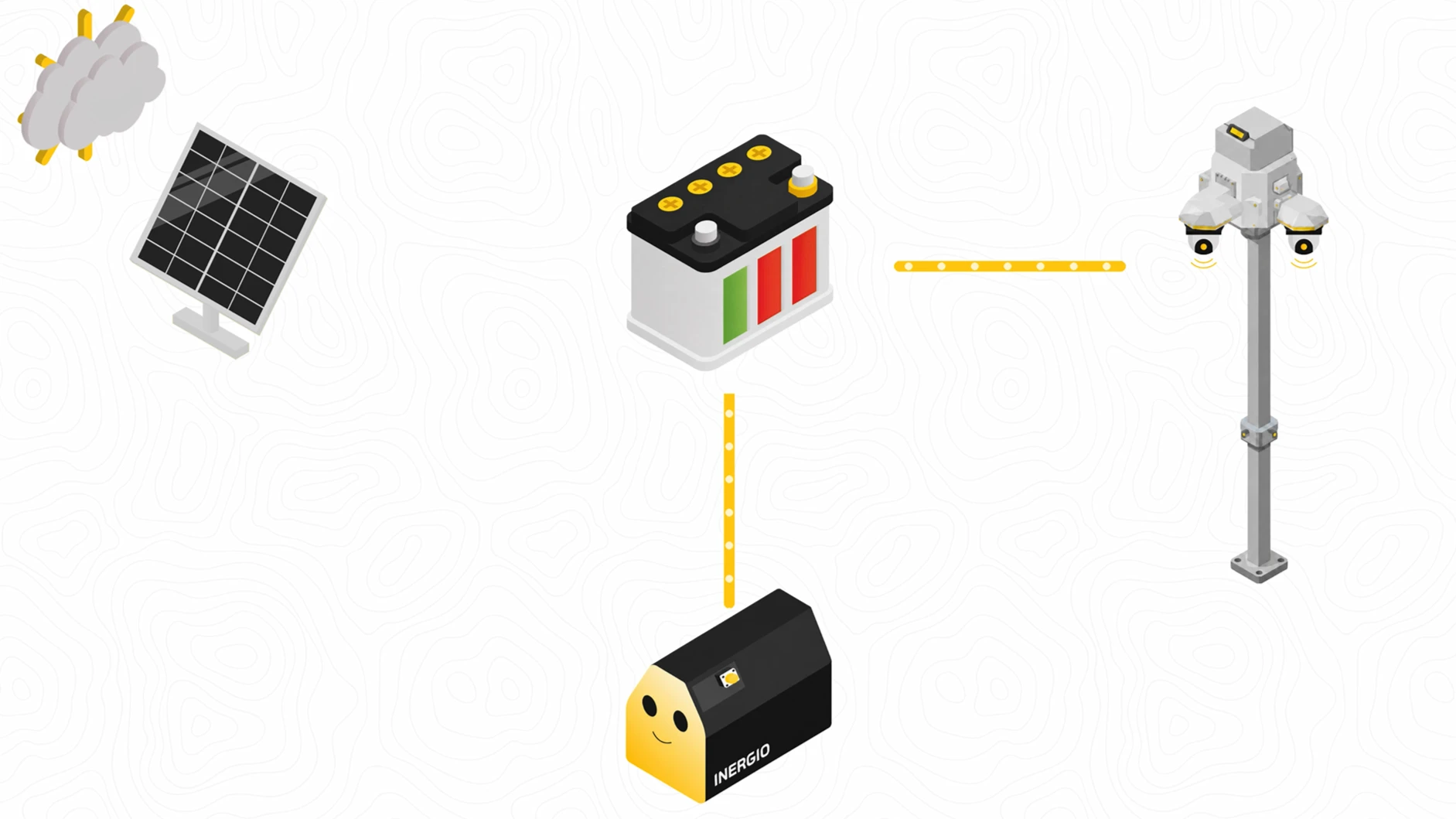
This hybrid structure lets each technology work according to its strengths: solar contributes whenever it is available, the battery manages immediate demand, and the SOFC protects long-duration autonomy.
A fuller explanation is available in our article on Why hybrid off-grid systems need more than batteries.
Where SOFC technology fits in the field
SOFCs are particularly relevant where demand is modest but sustained, downtime is not negotiable, and repeated site visits are costly or difficult.
Surveillance trailers need continuous power for cameras, communications and processing. Traffic systems must remain active throughout a deployment. Environmental stations cannot recover data that was never recorded, while remote industrial and oil and gas assets depend on uninterrupted monitoring and control.
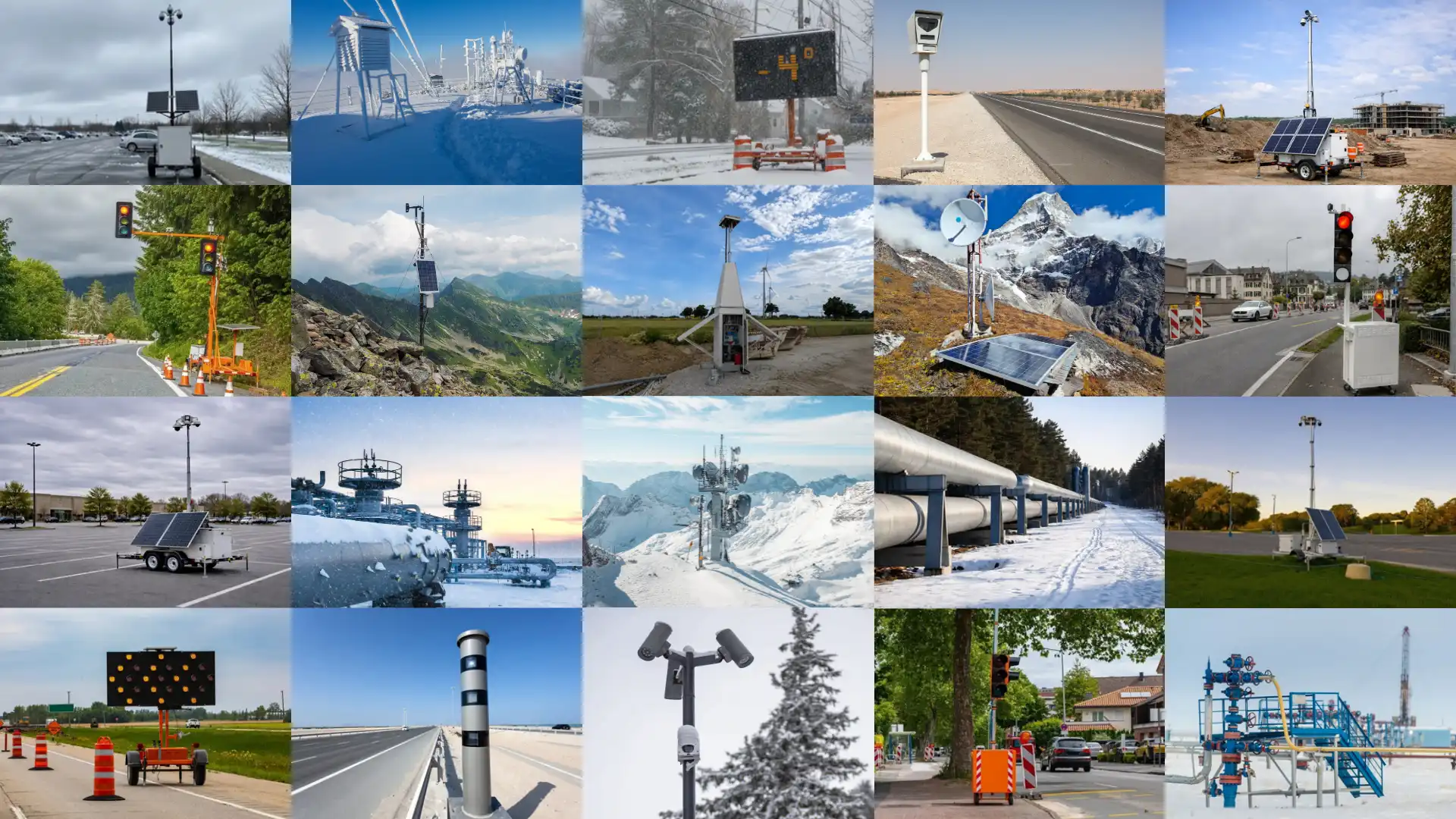
Several characteristics of SOFC technology align directly with these needs.
• The electrochemical core generates electricity without the engine, pistons or lubricating system of a combustion generator. With no oil changes and fewer sources of mechanical wear, the system can operate for long periods with minimal maintenance and fewer site interventions.
• Clean and quiet operation expands where the system can be deployed. INERGIO Mini operates below 50 dB at one metre, supporting surveillance, traffic and monitoring equipment in urban, residential and night-time environments.
• Efficient fuel conversion reduces fuel consumption and lifecycle CO₂ emissions compared with small conventional generators operating at low loads, while exhaust post-processing supports a cleaner local emissions profile.
• Fuel flexibility also becomes an operational benefit. INERGIO Mini uses standard commercial propane rather than depending on pure hydrogen infrastructure or proprietary cartridges. Propane’s high energy density provides long stored autonomy without requiring an impractically large battery bank, while cylinders and tanks support simple storage, transport and refuelling.
• Longer runtime from the fuel carried to site means fewer refuelling visits and more predictable operations.
The fit is less natural when a completely cold generator must provide power instantly, when operation lasts only a few minutes, or when large transient loads must be handled without a battery. SOFCs create their strongest value where sustained energy, autonomy, quiet operation and reduced intervention matter more than instant cold start.
Where SOFC science becomes field-ready: INERGIO Mini
INERGIO Mini is where these elements come together in a compact 140 - 170W power system for low-power off-grid and backup applications. Commercial propane is prepared and reformed before reaching the planar SOFC stack, while power conditioning, automated control, exhaust treatment, battery interaction and remote monitoring coordinate the complete process.
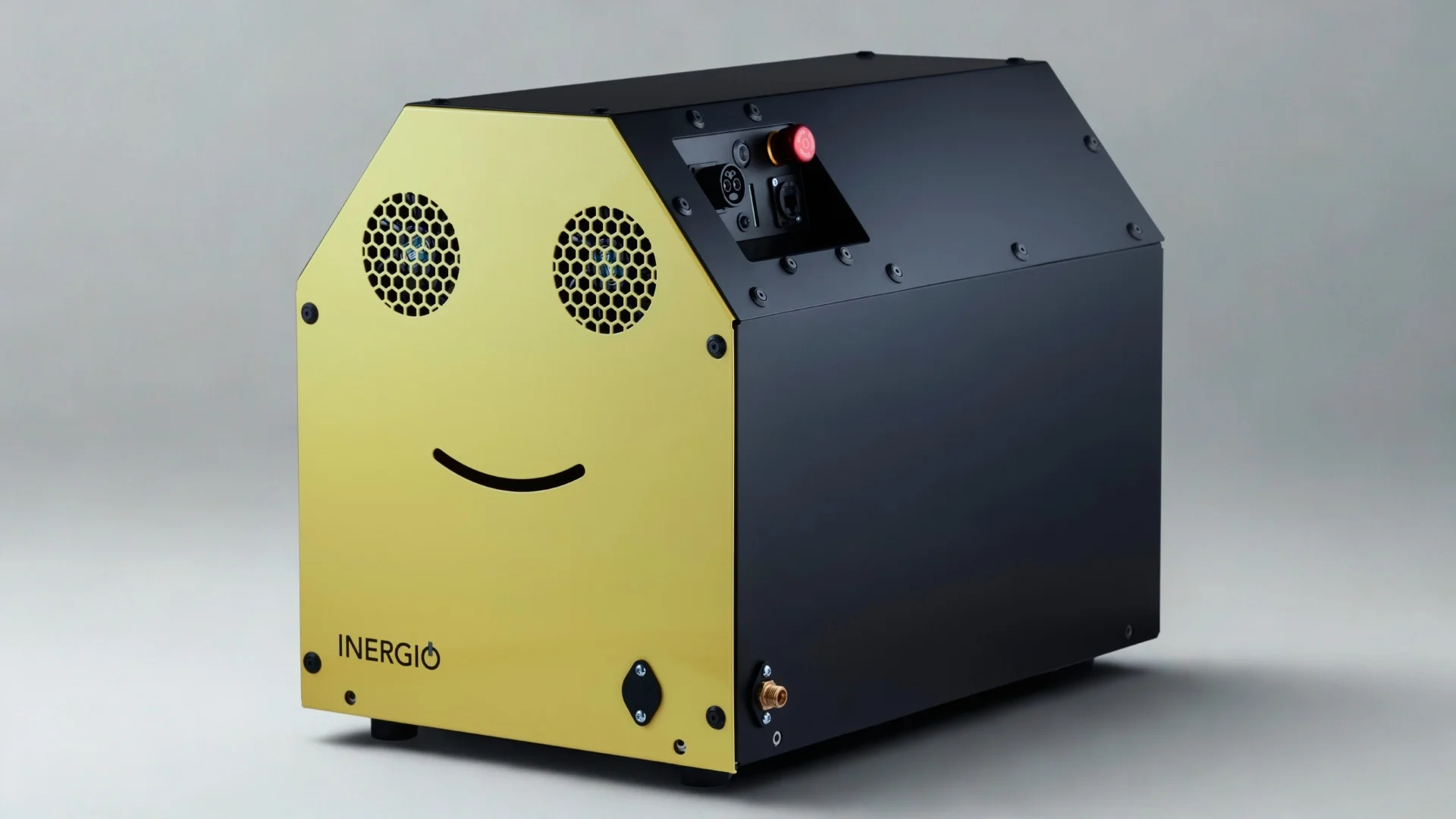
Designed to provide reliable, sustained energy to batteries powering remote equipment, INERGIO Mini can support a solar-battery system during prolonged low-solar periods or operate as the primary energy source where solar is unavailable or impractical. Its fuel-processing architecture combines the fuel flexibility of SOFC technology with the practical advantages of commercial propane: established supply channels, high stored energy and long autonomy.
Quiet operation, minimal maintenance and remote visibility help reduce site intervention while keeping critical equipment powered. The result becomes visible in the field: cameras remain online, traffic systems continue operating, environmental data keeps flowing and remote industrial assets remain connected.
A microscopic ion moves only from one position in a ceramic lattice to the next. Organised across cells, a planar stack and a controlled power system, those movements become reliable energy for infrastructure operating far beyond the grid.