
Understanding CO₂ emissions in off-grid energy systems
A practical view on how CO₂ impact is measured and compared
Looking beyond operational emissions
(The article provides an overview of the main factors driving CO₂ impact in off-grid energy systems. For a detailed breakdown of data sources, methodology, assumptions, and lifecycle calculations, read our full analysis.)
When evaluating off-grid power solutions, CO₂ emissions are often reduced to a simple question: what happens during operation?
This is only part of the picture. Emissions are the result of a full system and they come from how equipment is built, how fuel is produced, and how efficiently energy is generated in the field.
In off-grid operations, the objective is not to identify a theoretical “clean” solution.
It is to deploy a system that delivers reliable power with the lowest real-world emissions.
Where CO₂ emissions come from in off-grid energy systems
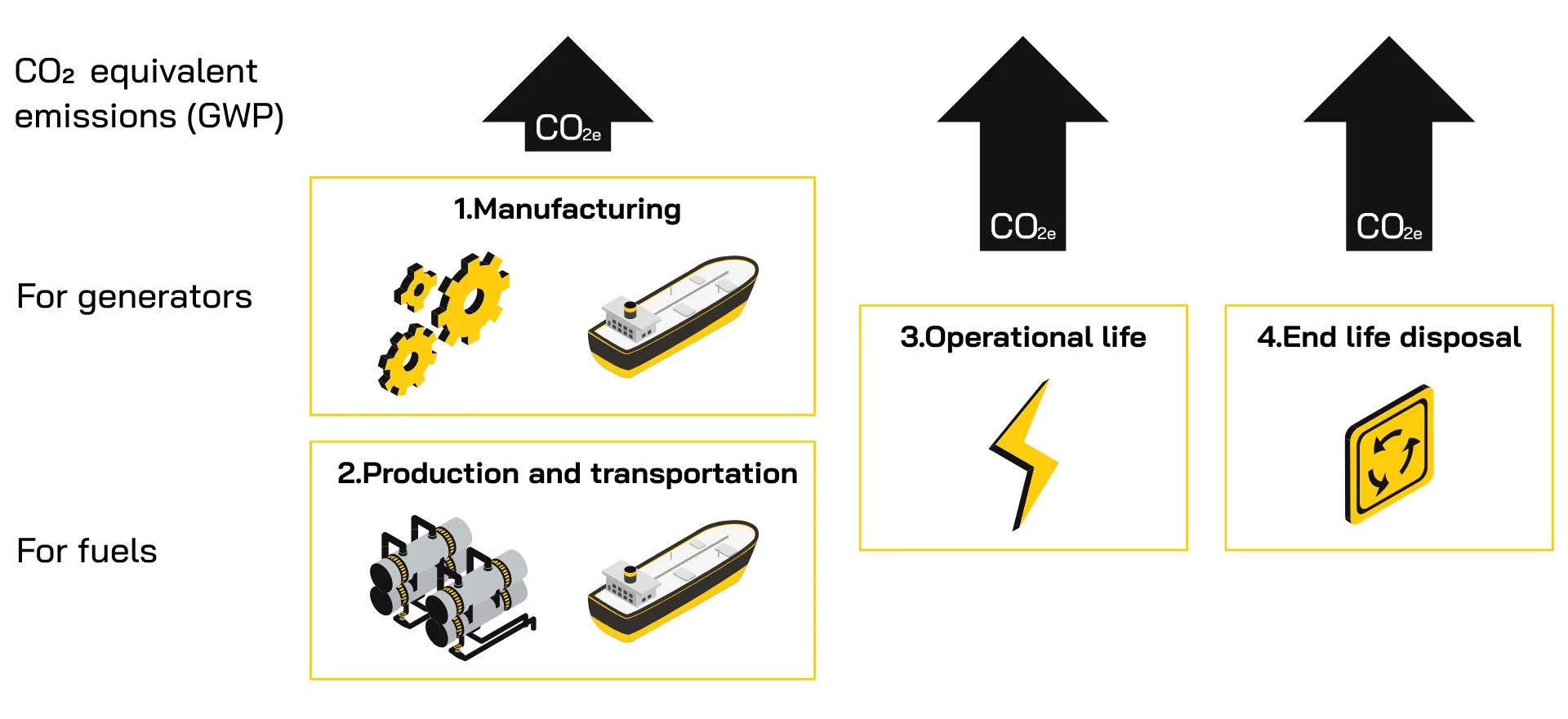
Emissions are measured in grams of CO₂-equivalent per kilowatt-hour (g CO₂-eq per kWh). This allows direct comparison across technologies and fuels. In practice, three factors define the footprint of an energy system:
• Generator production and installation
• Fuel production and transport
• Conversion efficiency during operation
All three matter, but they do not contribute equally.
In off-grid environments, operational efficiency dominates. Systems run continuously, and small inefficiencies compound into large emission differences over time. This is where most conventional solutions fall short.
The baseline: conventional diesel and gasoline generators
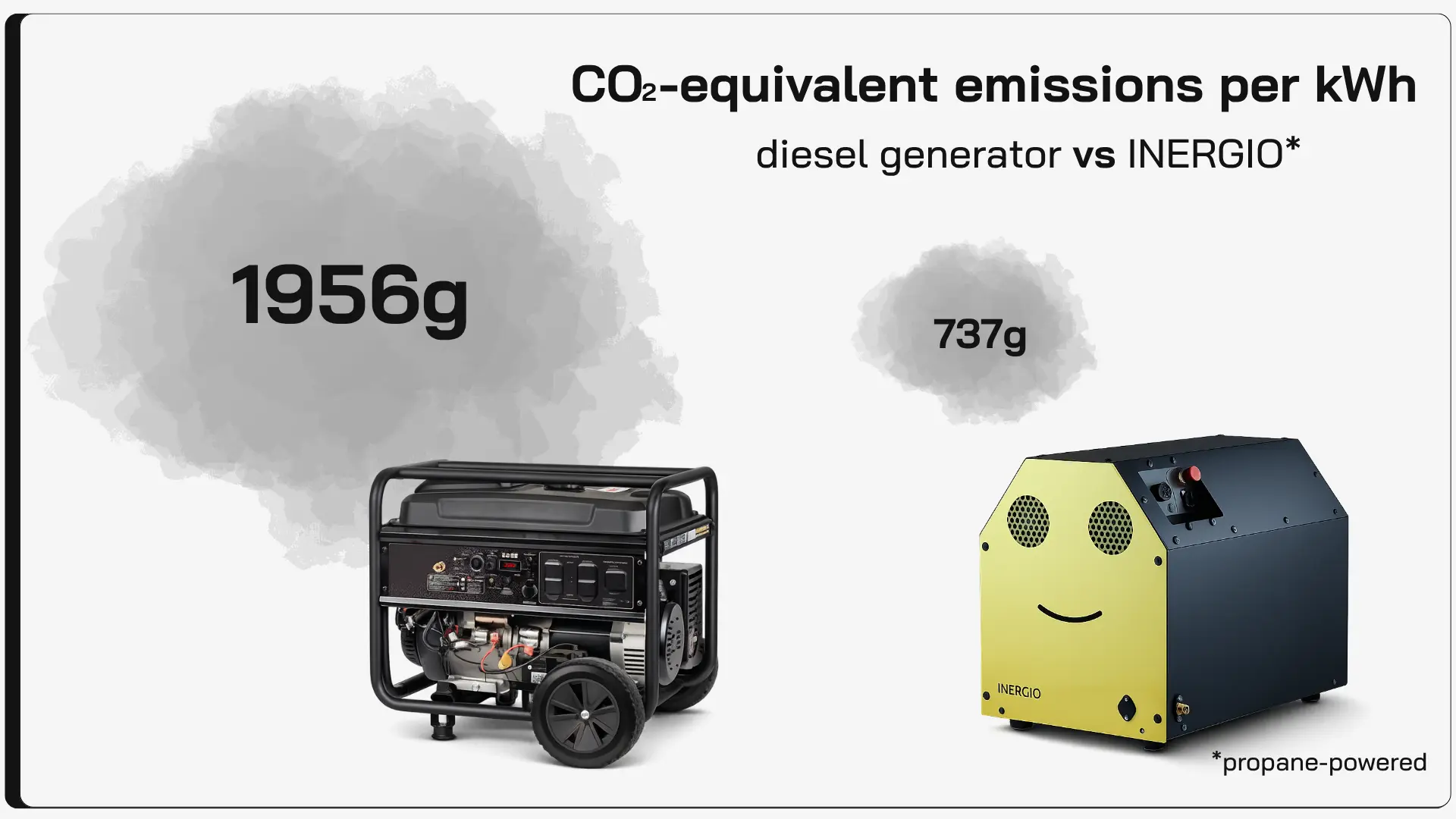
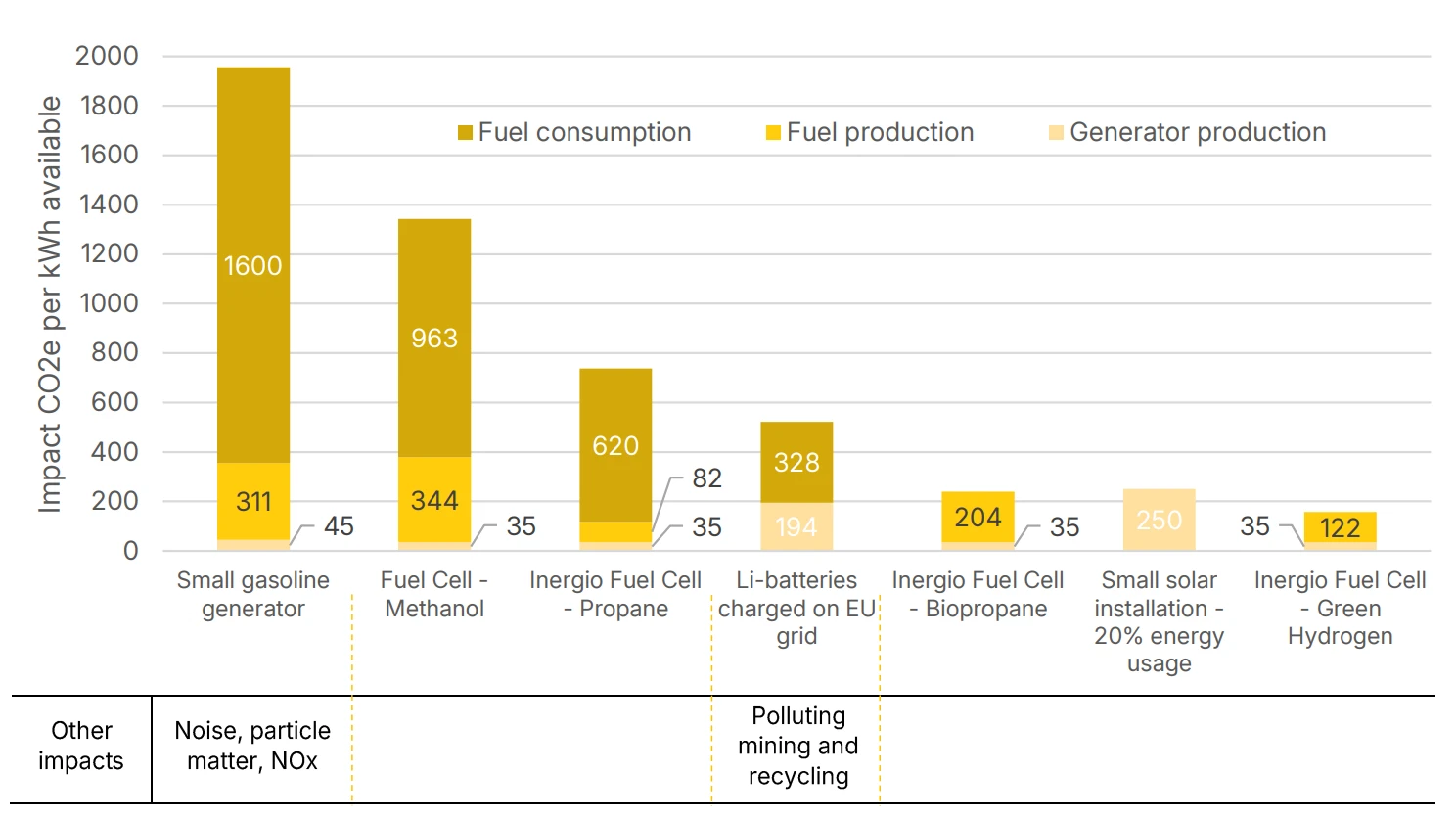
Small gasoline or diesel generators remain widely used in off-grid applications. They are simple, but inherently inefficient. In real conditions, they can exceed 1900 g CO₂-eq per kWh of usable energy. This is not driven by fuel alone. It is the combination of:
• Low conversion efficiency (around 16%)
• Continuous operation
• High fuel consumption per kWh
For comparison, diesel fuel alone already carries around 304 g CO₂-eq per kWh of energy potential, before efficiency losses are considered. Once converted in a small generator, this multiplies into significantly higher real emissions.
For operations teams, this translates directly into:
• Higher emissions
• Higher fuel logistics
• Higher operational cost exposure
A different approach: efficient fuel cell systems for off-grid power
Fuel cell systems generate power without combustion. They convert the chemical energy directly to electricity without any intermediate steps, which significantly improves efficiency. INERGIO’s solid oxide fuel cell systems are designed for uninterrupted, off-grid operation. They maintain stable efficiency over long runtimes and operate across multiple fuels.
In practical terms:
• 737 g CO₂-eq per kWh with propane
• 239 g CO₂-eq per kWh with bio-propane
• 157 g CO₂-eq per kWh with green hydrogen
This represents a reduction of approximately 60–90% compared with conventional generators, depending on the fuel. The difference is not theoretical and it comes directly from:
• Higher conversion efficiency
• Lower fuel consumption per kWh
• Stable performance over long operating periods
Why fuel production and usage both matter for emissions
Fuel choice has a direct impact on emissions but it does not tell the full story. The same fuel can lead to very different outcomes depending on how it is produced and how efficiently it is used.
Hydrogen is a clear example:
• 55 g CO₂-eq per kWh when produced with renewable energy
• Up to 405 g CO₂-eq per kWh when produced using average grid electricity
A large share of hydrogen production today still relies on natural gas reforming, which increases its overall footprint.
The same applies to propane and bio-propane:
• Propane: ~244 g CO₂-eq per kWh
• Bio-propane: ~92 g CO₂-eq per kWh
INERGIO systems are designed to operate across these fuels. This allows emissions to be reduced further without changing the system architecture.
Why real operating conditions change emissions outcomes
Many energy solutions are evaluated under ideal assumptions. Off-grid deployments rarely match those conditions.
Solar illustrates this gap. While its theoretical emissions are low (around 40 to 50 g CO₂-eq per kWh at utility scale), real installations are often oversized to ensure availability.
In off-grid scenarios, this can increase effective emissions to around 250 g CO₂-eq per kWh, due to low utilization. Under-utilization directly increases the carbon footprint per kWh.
In contrast, systems designed for continuous operation maintain:
• Stable efficiency
• Predictable performance
• Consistent emissions profile
This is not a theoretical advantage. It directly impacts both emissions and operational reliability.
What this means for off-grid operations and system selection
Reducing emissions in off-grid power is not about selecting a single “green” technology.
It is about combining:
• High efficiency over long operating periods
• Flexible and lower-impact fuel options
• Reliable, continuous performance
Systems that perform consistently across these dimensions deliver:
• Lower emissions
• Lower operational risk
• Greater predictability in the field
In most off-grid applications, like mobile surveillance, the comparison is clear. Conventional generators remain the highest-emission option due to low efficiency and continuous fuel consumption. More efficient systems, such as INERGIO’s fuel cell technology, reduce emissions immediately while maintaining operational reliability. Additional reductions can be achieved through fuel choice, without increasing system complexity.
This makes it possible to improve environmental performance in a measurable way, without changing how operations are run.

Go deeper: full CO₂ emissions analysis and methodology
This article highlights the main conclusions and practical comparisons. For a detailed breakdown of data sources, methodology, assumptions, and lifecycle calculations, read our full analysis.