
3 reasons why propane is the ideal fuel for powering off-grid operations
How propane’s fuel properties shape autonomy, operating cost, and reliability in off-grid systems
Reliable off-grid power starts with the right fuel and power system
Powering equipment in remote or off-grid locations is not primarily a technology challenge. It is an operational one. Sites are often difficult to access, exposed to harsh weather, and expected to run continuously with minimal intervention. In these conditions, the choice of fuel becomes just as important as the power system itself. This is also where fuel cells for off-grid power offer a different approach, converting fuel into electricity electrochemically rather than through combustion and mechanical generation.
Propane stands out as a strong candidate for off-grid power. It is widely available, energy dense, and comparatively cost efficient. These fuel properties alone simplify logistics and support longer autonomous operation.
At the same time, electrical efficiency, runtime, and cost per kilowatt hour are ultimately determined by how efficiently a system converts fuel into electricity. Fuel properties create the potential. Conversion technology determines how much of that potential is realized.
INERGIO Mini is a propane fuel cell system based on Solid Oxide Fuel Cell technology that converts the chemical energy in fuel into electricity through an electrochemical process, without relying on a combustion engine or moving parts. Its operating principle and system architecture differ from those of conventional generators and low-temperature fuel cell technologies. Using propane, INERGIO Mini generates 3.9 kWh of electrical energy per kilogram of fuel (1.8 kWh/lb).
This article explores the advantages of propane as a fuel and explains how those advantages are further strengthened when converted efficiently into electricity.
1. Propane is widely available and easy to source
One of the biggest challenges in off-grid operations is fuel logistics. Proprietary or highly specialized fuels provide an energy source solution, but they introduce operational complexity in real-world deployments.
This is where propane stands apart. Propane is widely available across the Northern hemisphere through established commercial supply chains. In addition, compared to hydrogen or proprietary methanol blends, it does not require dedicated infrastructure or specialized suppliers. It is the same commercial propane used for heating, cooking, and industrial applications.
This wide availability simplifies procurement, reduces transport complexity, and lowers overall fuel handling costs.
2. Propane requires simple handling and low-risk logistics
Off-grid deployments often lack space, secondary containment, and personnel trained for complex fuel handling.
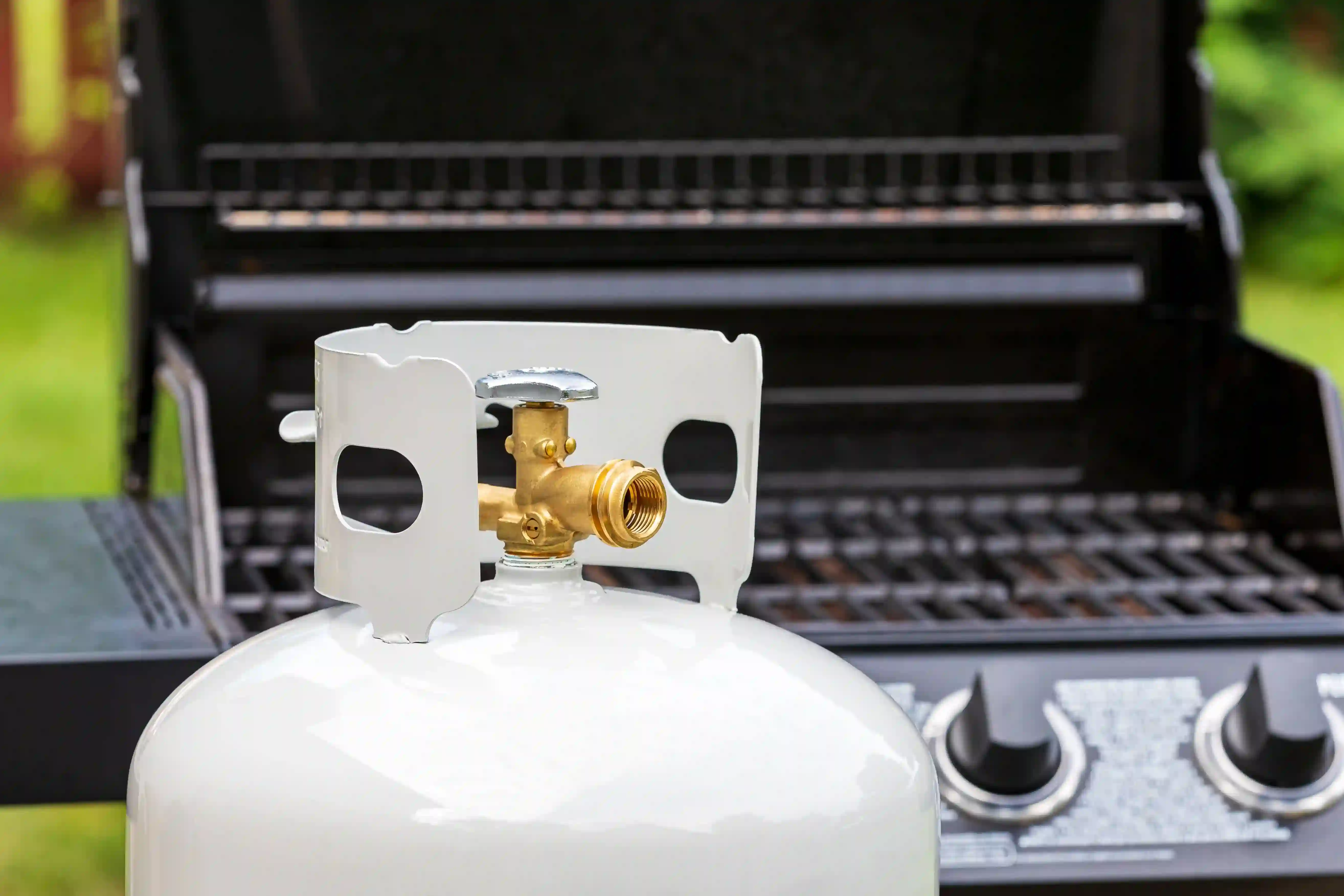
Propane is stored in sealed, pressurized cylinders or tanks, which simplifies transport and on-site storage. When paired with an INERGIO Mini power system, fuel handling is limited to connecting standard cylinders, similar to those used in residential or industrial applications. Unlike methanol, propane does not create the same liquid contamination risk in the event of a leak. And unlike diesel, it does not require secondary spill containment or fuel polishing, as it is stored in sealed, pressurized cylinders and does not degrade over time.

3. Propane delivers more energy and lower fuel cost per volume
As previously explained, propane simplifies logistics on its own. Combined with INERGIO’s efficient and autonomous operation, these advantages become even more powerful through extended runtime and reduced refueling cycles.
To understand why this combination works so effectively, it helps to first look at the properties of the fuel itself.
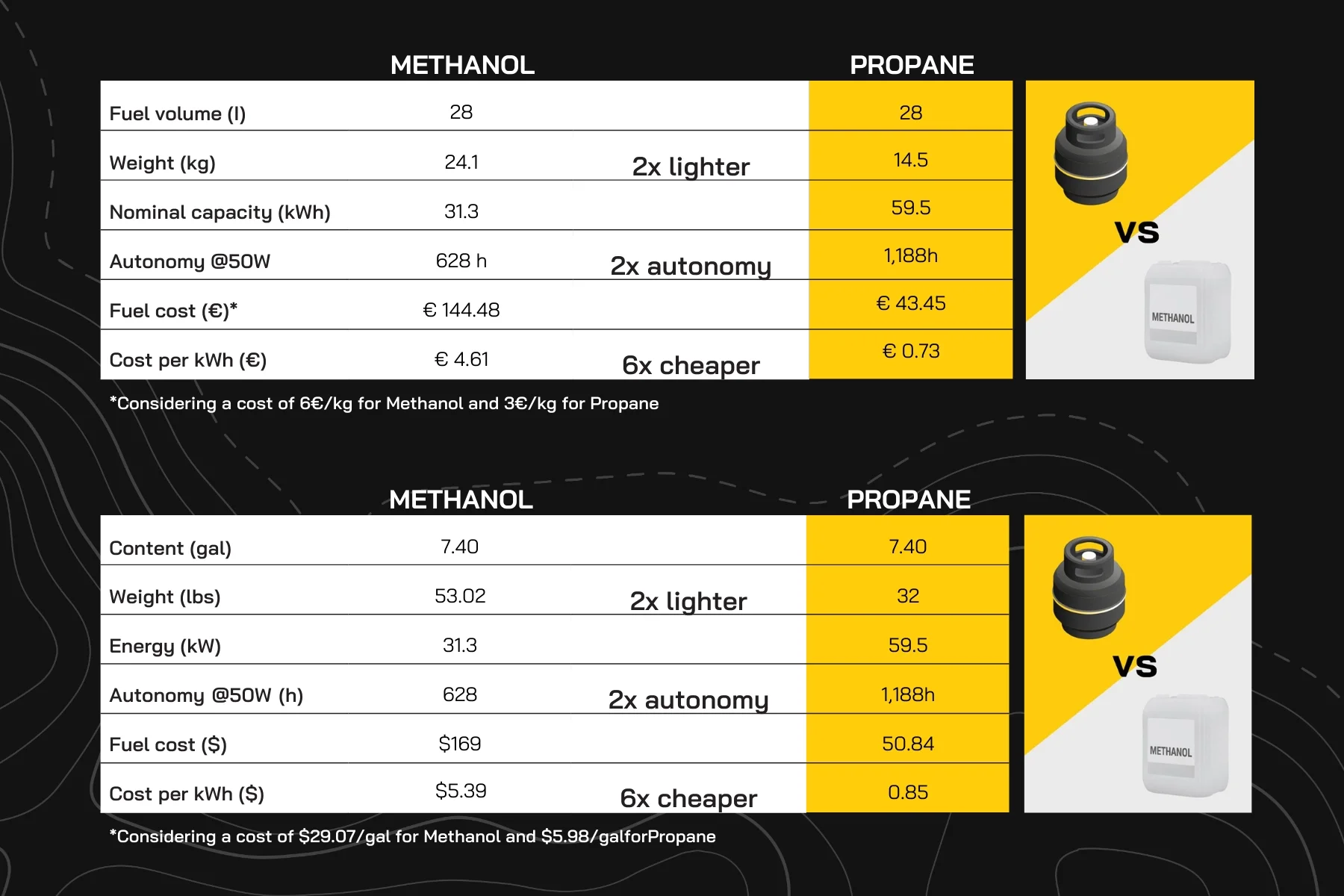
When fuels are compared at the same volume, the differences between propane and methanol become immediately clear. For 28 liters of fuel, propane weighs 14.5 kg, while methanol weighs 24.1 kg. In other words, propane is nearly twice as light for the same volume.
More importantly, propane offers significantly higher energy density. Those same 28 liters provide 59.5 kWh of nominal energy capacity, compared to 31.3 kWh for methanol, almost double the usable energy.
What does this mean in practice? At a steady 50W load, methanol delivers around 628 hours of autonomy. The same volume of propane delivers approximately 1,188 hours. That is nearly twice the operating time before refueling is required.
The economic impact is even more striking. Assuming 6 euros per kilogram for methanol and 3 euros per kilogram for propane at 2026 prices, 28 liters of methanol cost 144.48 euros, while propane costs 43.45 euros. On an energy basis, this corresponds to 4.61 euros per kWh for methanol versus 0.73 euros per kWh for propane, making propane about six times cheaper per kilowatt hour.
Taken together, propane provides almost twice the energy per volume, significantly longer autonomy, and substantially lower fuel cost. For off-grid infrastructure, these differences are highly significant. They directly influence refueling intervals, transport requirements, and overall deployment duration without intervention.
INERGIO’s propane fuel cell technology delivers value in the field
Choosing a fuel for off-grid power is not about specifications in isolation. It is about how fuel properties and conversion technology work together under real-world conditions.
Propane brings high energy density, low transport weight, and significantly lower cost per kilowatt hour compared to methanol. In a high-efficiency fuel cell system like INERGIO Mini, those fuel properties translate into measurable operational benefits.
INERGIO Mini is a high-efficiency propane fuel cell system that operates reliably from –40°C to +55°C (–40 to 131 °F), supports true cold starts, and is designed for long-term deployment in demanding environments.
For surveillance systems, traffic management installations, oil and gas monitoring, and other remote infrastructure, this combination defines how often refueling is required, how much equipment must be transported, and how consistently systems remain online.
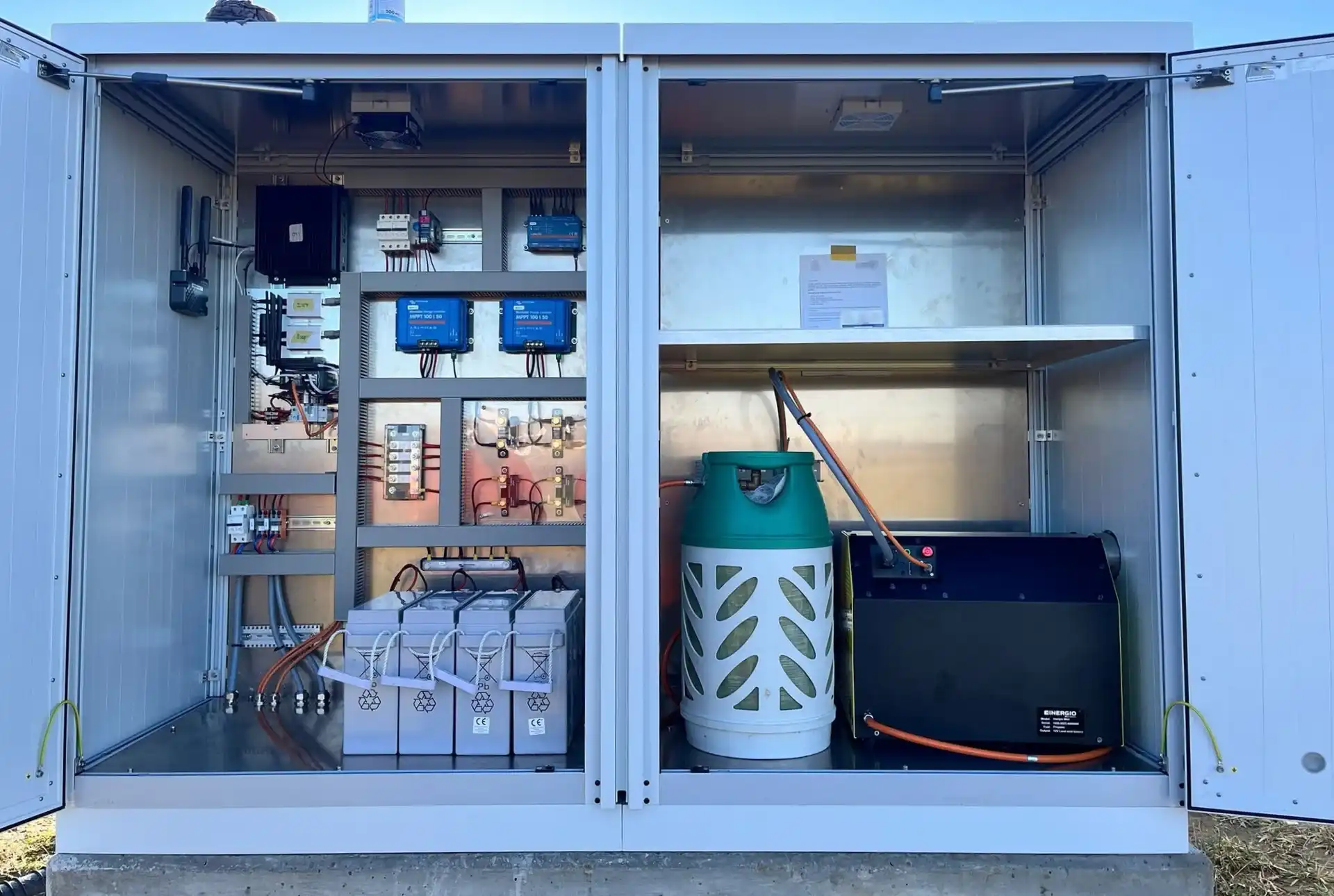
Reliable off-grid power depends on selecting a fuel that simplifies logistics and a system that extracts maximum value from that fuel. Propane and INERGIO Mini together provide an optimal balance of autonomy, cost efficiency, and operational reliability.